

Have you ever wondered what secrets lie behind your piano’s serial number? This small string of digits holds the key to unlocking your instrument’s history and age. Understanding this number can be crucial for identifying your piano’s make and model, especially if you’re considering restoration or resale.
In this guide, you will learn the complete process of locating and interpreting the serial number on your piano. Whether you own a grand or an upright, we will walk you through practical steps that can be followed immediately. You will discover how to differentiate the actual serial number from other numbers that may appear on various components of your instrument.
By the end of this article, you will have a clear, step-by-step method to confidently identify any piano’s serial number. Resources like the Blue Book of Pianos and professional consultants at www.vestapiano.ca will also be highlighted to assist you further.
Key Takeaways
- Learn to locate your piano’s serial number effectively.
- Understand the significance of the serial number in dating your piano.
- Discover common myths that can lead to incorrect dating.
- Utilize resources like online databases for accurate identification.
- Get tips for both antique and modern pianos.
Understanding Piano Serial Numbers: What They Are and Why They Matter
The serial number on your piano is more than just a code; it’s a gateway to its origins. This unique identifier, assigned by the manufacturer, helps you learn about your instrument’s history and specifications. Understanding these numbers is essential for any piano owner.
Definition and Purpose of Serial Numbers
Serial numbers serve as unique identifiers that manufacturers assign to each individual piano during the production process. Think of them as fingerprints for your instrument. They help track your piano’s age and origin, making them crucial for both enthusiasts and potential buyers.
How Serial Numbers Help Identify Your Piano's Age and Origin
These numbers allow you to pinpoint the year your piano was made by comparing the digits against published manufacturer records and serial number lists. This process is essential for verifying the provenance of your instrument, which directly impacts its value and historical significance in the piano industry.
Common Serial Number Formats and Digits
Common serial number formats vary by brand and era. Most consist of 2 to 7 digits, although some manufacturers used letters or combined formats. The number of digits often correlates with the production volume of the factory. Larger manufacturers typically use longer numbers over time.
Some piano makers even started their serial numbers at arbitrary figures rather than at 1. This can complicate the dating process if you are unaware of this practice. Knowing how to read and interpret these digits is the foundation for successfully identifying your piano’s manufacturing date.
If you are a Canadian piano owner, resources like www.vestapiano.ca can help you interpret serial numbers and understand your instrument’s background.
Where to Find the Serial Number on Your Piano
Locating the serial number on your piano can be easier than you think, provided you know the right spots. Each type of piano has specific areas where the serial number is typically found. Understanding these locations can save you time and effort.
Locating Serial Numbers on Grand Pianos
For grand pianos, the serial number is often found in several key locations:
- Check the cast iron frame first. The serial number is usually stamped or painted near the tuning pins or along the front edge.
- The soundboard frequently displays the serial number alongside the brand name or trademark. Open the lid and look inside to find it.
- Look between the reed pegs or inside the body, typically in the left-hand corners.
- Some numbers may be hidden in hard-to-reach places, requiring careful inspection or partial disassembly.
Locating Serial Numbers on Upright Pianos
Upright pianos have their own set of common locations for serial numbers:
- The back of the instrument is often the most common spot, typically in the upper portion of the wooden frame.
- Check the cast iron frame, which is usually visible after opening the top lid and looking down at the plate.
- Other possible locations include the inner side walls and removable case parts, such as the music desk.
- Sometimes, the number is imprinted into the wood of the casework on the top edge.
Other Possible Locations of Serial Numbers Inside the Piano
In addition to the main areas mentioned, there are other potential spots to check:
- Look underneath the pedal unit on grand pianos.
- Some serial numbers may only be visible after removing certain components, so patience is key.
- Three-digit numbers found on removable wooden parts often represent just the last three digits of the full serial number.
If you cannot locate the serial number after checking all common locations, professional consultants at www.vestapiano.ca can provide expert assistance with identification.
Distinguishing Serial Numbers from Other Piano Identification Numbers
Inside your piano, you may discover several numbers, but not all of them are the serial number. Understanding the differences is crucial for accurately identifying your instrument. Many pianos have various identifiers that can lead to confusion.
One common point of confusion arises between case numbers and serial numbers. These two types of numbers serve different purposes. Knowing how to distinguish them can save you from misidentifying your piano’s history.
Case Numbers vs. Serial Numbers
Case numbers were used by factories to track individual piano cabinets during the hand-made assembly process. Often, these numbers are confused with actual serial numbers. However, they do not indicate the age or specific identity of the piano.
Numbers on Soundboards, Iron Frames, and Action Components
When you look inside your piano, you may find numbers on soundboards and iron frames. The numbers found on soundboards are more likely to be the genuine serial number, especially when they match the brand’s published format and digit count. Conversely, numbers cast into the iron frame are typically mold or batch numbers for the frame itself. They do not identify your specific instrument or its age.
Additionally, action components often bear their own manufacturing numbers. These relate to the action maker’s production sequence rather than the piano’s overall serial number.
Why Multiple Numbers Appear and Which One to Trust
It is common to encounter multiple numbers inside your piano, including case numbers, part numbers, and the true serial number. The serial number you should trust is usually the longest number that appears consistently across multiple locations, such as on the soundboard and case.
Understanding why multiple numbers appear helps you avoid the common mistake of using a case number or action number to date your piano incorrectly. When in doubt about which number to use, consulting experts at www.vestapiano.ca can save you from basing your piano’s history on incorrect information.
| Type of Number | Description | Importance |
|---|---|---|
| Case Number | Used to track piano cabinets during assembly | Not indicative of age or identity |
| Serial Number | Unique identifier for each piano | Indicates age and model |
| Soundboard Number | Often the true serial number | Helps verify the piano’s identity |
| Iron Frame Number | Mold or batch number | Not specific to the piano |
| Action Number | Manufacturing number for action components | Relates to action maker’s production |
How to Use Serial Numbers to Date Your Piano
Understanding how to date your piano using its unique identifier can reveal fascinating insights about its history. The process of dating a piano relies heavily on having both a name and a number. This information is essential for accurate identification.
Published serial number lists, such as those found in the Pierce Piano Atlas and various online databases, allow you to match your number against known production years for your brand. To use these lists effectively, you must first identify your piano’s brand name accurately. Serial number sequences are unique to each manufacturer, making this step crucial.
It’s important to recognize the limitations of serial number dating. Many published lists contain inaccuracies, conflicting data, or estimated ranges rather than confirmed dates. Variations in serial number dating can arise from several factors:
- Manufacturers may start numbers at arbitrary figures.
- Different models might use separate sequences.
- Ownership changes can also affect the numbering system.
When interpreting dates, understand the difference between approximate and confirmed dates. Approximate dates are educated estimates based on available records. In contrast, confirmed dates come from factory ledgers or original sales documentation. Some manufacturers allotted a thousand numbers per year, regardless of actual production volume, which can skew the apparent age of your instrument.
The year indicated by a serial number list may represent the last number produced in that calendar year. However, conventions vary by brand and should be verified. For Canadian piano owners, www.vestapiano.ca offers expertise in navigating these dating challenges and interpreting serial number information accurately.
| Factor | Description | Impact on Dating |
|---|---|---|
| Published Lists | Resources like the Pierce Piano Atlas | Provide known production years |
| Brand Identification | Accurate brand name recognition | Essential for correct sequence matching |
| Inaccuracies | Conflicting data in published lists | Can lead to incorrect dating |
| Arbitrary Starting Points | Some manufacturers start at random numbers | Complicates dating process |
| Confirmed Dates | Factory records or sales documentation | More reliable for accurate dating |
Step-by-Step Guide: How Do I Look Up a Piano Serial Number?
Your piano’s serial number holds vital clues to its history and significance. Understanding how to look it up can be straightforward if you follow a few simple steps. This guide will walk you through the process, ensuring you gather all necessary information.
Step 1: Locate the Serial Number
Begin by thoroughly inspecting your piano’s interior and exterior. For grand pianos, the serial number is usually found on the inside, often stamped on the cast iron frame or soundboard. For upright pianos, check the back panel. You may need a flashlight and possibly a mirror to examine hard-to-reach areas.
Remember, the number may be imprinted in wood, painted on metal, or stamped in ink. This step is crucial, as the serial number is the foundation for all further identification.
Step 2: Identify Your Piano's Brand Name
Next, confirm the exact brand name on your piano. Many instruments bear stencil names or were manufactured by a different company than what appears on the label. Correctly identifying your piano’s brand name is essential, as serial number lists are organized by manufacturer. Using the wrong list will yield incorrect results.
Step 3: Find a Serial Number List for Your Brand
Now, search for a serial number list specific to your brand. Resources like the Pierce Piano Atlas, Klaviano databases, or the Blue Book of Pianos can be invaluable. For Canadian piano owners, www.vestapiano.ca provides access to verified serial number lists, helping you locate the correct reference for your instrument.
Step 4: Compare Your Serial Number With Published Ranges
Once you have the list, compare your serial number against the published ranges. Check to see if your number falls between the lowest and highest numbers for a given year. This comparison will help you narrow down the age of your piano.
Step 5: Verify Your Findings With Additional Information
Finally, verify your findings by cross-referencing with additional information. Look for date-marks inside the piano, as these can often provide a more accurate guide to the age of the instrument than the serial number alone. Consulting with experts at www.vestapiano.ca can further ensure the accuracy of your findings.
| Step | Description | Importance |
|---|---|---|
| 1 | Locate the serial number on your piano. | Essential for identification. |
| 2 | Identify the brand name accurately. | Critical for using the correct serial number list. |
| 3 | Find a serial number list for your brand. | Provides necessary reference data. |
| 4 | Compare your serial number with published ranges. | Narrows down the production year. |
| 5 | Verify findings with additional information. | Ensures accuracy in dating your piano. |
Common Brands and Their Serial Number Ranges
Each piano brand has its own unique serial number sequences that reveal valuable information about its history. Understanding these ranges can assist you in dating your instrument accurately. Here are some examples from well-known brands:
Examples from Well-Known Brands
- Bechstein: Their serial numbers started at 176 in 1853 and reached 186,144 by 1996. This clear sequence makes dating straightforward.
- Chickering & Sons: This historic brand began its serial numbers at 100 in 1823, reaching 248,500 by 1982. They maintained consistent annual increments.
- Baldwin/Hamilton: Baldwin pianos show steady growth from serial number 16,000 in 1900 to over 477,000 by 2000, reflecting high-volume factory output.
Special Cases: Brands with Complex or Multiple Serial Number Series
Some brands, like Bluthner, have compact serial number ranges. For instance, their numbers progressed from 100,000 in 1920 to only 158,000 by 1996, indicating lower production volumes. Similarly, Bosendorfer exemplifies limited production, with serial numbers moving from 15,640 in 1900 to just 33,444 by 1980, reflecting their hand-crafted approach.
How Production Scaling Affects Serial Number Patterns
Production scaling significantly influences serial number patterns. High-volume manufacturers like Everett show rapid number progression, from 125,700 in 1960 to 373,000 by 1996. For Canadian owners needing assistance interpreting serial number ranges for brands like Bechstein, Chickering, or Baldwin, www.vestapiano.ca offers specialized knowledge tailored to the Canadian piano market.
Avoiding Myths and Mistakes in Piano Serial Number Research
When it comes to researching your piano’s history, myths and misunderstandings can lead you astray. Many believe that serial numbers provide an infallible date for their pianos, but this is often a misconception. Only a few manufacturers have published accurate dates linked to their serial numbers, and many entries are misleading.
Conflicting data from various sources can create confusion. For instance, the Pierce Piano Atlas may provide different manufacturing years for the same serial number compared to online databases. This inconsistency can mislead you when trying to determine your piano’s age.
Additionally, the original Piano Atlas by N.E. Michel, while groundbreaking, contains numerous errors and duplicated entries. These inaccuracies have been perpetuated by other publications, making it essential to verify information from reliable sources.
Historical events have also impacted piano production and record-keeping. Wars and riots disrupted many factories, leading to gaps in serial number sequences. For example, during World War II, several piano manufacturers shifted to wartime production, causing irregularities in their serial number records.
Factory ownership changes, mergers, and acquisitions can further complicate matters. New serial number series often emerge from these transitions, making it difficult to trace a continuous production history.
Be cautious of numbers that resemble years. Four-digit serial numbers from the 1800s can easily be misinterpreted as dates if you are not familiar with the manufacturer’s conventions.
To avoid these common pitfalls, consult www.vestapiano.ca. They provide expert verification services that cross-reference multiple data sources and physical piano characteristics for accurate dating.
Resources and Tools for Piano Serial Number Lookup
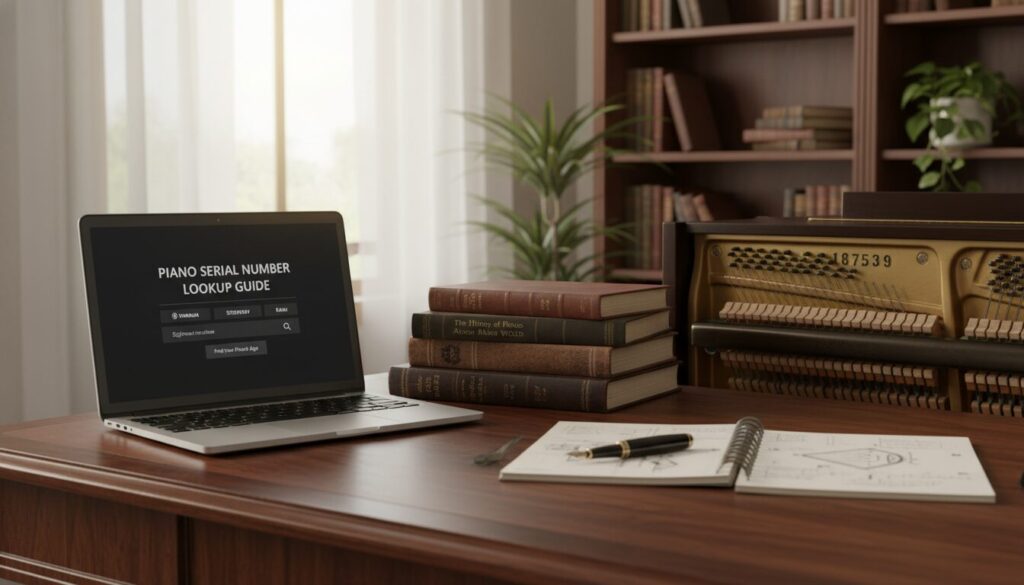
Finding reliable resources for your piano’s serial number can enhance your understanding of its history. Various tools and databases are available to help you gather information about your instrument. Utilizing these resources effectively can make the process much smoother.
Online Serial Number Databases
Online databases are invaluable for piano owners. Websites like Klaviano provide free access to verified serial number lists for many major brands. This allows you to quickly determine the age and model of your instrument.
The Blue Book of Pianos also offers a substantial database of serial number information. It includes piano values, making it a dual-purpose resource for both owners and buyers. If you encounter issues while searching for your serial number, contacting Klaviano consultants can provide further assistance.
Contacting Piano Experts and Consultants
Consulting with piano experts is often the most reliable approach. Professionals can cross-reference your serial number with unpublished records and physical characteristics of your instrument. For Canadian piano owners, www.vestapiano.ca serves as a dedicated resource, offering expert consultation and access to comprehensive serial number databases.
Using Visual Identification Alongside Serial Numbers
In addition to serial numbers, visual identification can offer a more complete picture. Design features, case styling, and internal components can confirm or challenge the dates associated with your serial number. Experts with access to extensive image archives can compare your piano’s characteristics against thousands of reference photos to estimate its age objectively.
Combining online database research with professional consultation ensures that you receive the most accurate information about your piano’s manufacturing date and history. When online resources yield conflicting results, reaching out to specialists at www.vestapiano.ca can resolve discrepancies and provide authoritative documentation for your instrument.
| Resource Type | Description | Benefits |
|---|---|---|
| Online Databases | Klaviano and Blue Book of Pianos | Free access to verified serial number lists and values |
| Piano Experts | Consultants with extensive knowledge | Cross-reference serial numbers with unpublished records |
| Visual Identification | Comparing design features and components | Provides additional context to serial number data |
How Serial Numbers Affect Your Piano's Value and History
Your piano’s serial number is a vital tool for uncovering its worth and historical significance. Understanding this number can help you trace the manufacturing date and confirm its authenticity as a specific brand and model.
When you know the age of your piano, it directly impacts its value. Older instruments may carry antique value, while newer ones are assessed based on their condition and brand reputation. Estimating piano worth involves a combination of serial number data, physical condition assessments, and market demand.
In the Canadian market, certain brands like Heintzman and Mason & Risch have unique value considerations tied to their serial number ranges. These factors can reveal whether your piano was made during a brand’s golden era or in periods of lower quality, significantly affecting its market value.
Understanding how serial numbers relate to piano worth helps you make informed decisions about purchasing, selling, insuring, or restoring your instrument. Professional appraisers often use serial numbers as a starting point for valuation. They combine this data with hands-on inspection to determine fair market value.
For accurate piano worth assessments in Canada, www.vestapiano.ca offers valuation services that incorporate serial number verification with comprehensive market analysis.
| Aspect | Description | Impact on Value |
|---|---|---|
| Provenance Verification | Tracing manufacturing date and brand authenticity | Confirms instrument’s historical significance |
| Age of Piano | Determined by serial number | Older pianos may have higher antique value |
| Physical Condition | Overall playability and tone quality | Directly influences market demand |
| Market Demand | Varies by brand and region | Affects resale value |
| Brand Specifics | Considerations for brands like Heintzman | Unique value tied to serial number ranges |
Recording and Preserving Your Piano's Serial Number Information
Documenting your piano’s serial number is a crucial step in understanding its history. Keeping accurate records can help you maintain its value and authenticity over time. Here are some best practices to ensure you capture all necessary details effectively.
Best Practices for Documenting Your Piano's Details
Start by recording the full serial number, brand name, and model designation. It’s also important to note the exact location where you found the number on the instrument. This comprehensive documentation will serve you well in the future.
Additionally, create a written record that includes any other numbers found on the case, action, soundboard, and iron frame. This will provide a thorough overview of your piano’s identification.
Photographing and Archiving Serial Number Locations
Photographing the serial number location is crucial. Clear images capture details that may fade over time. They also provide visual proof of the number’s placement and condition. Archiving these photographs digitally ensures you have a permanent record, even if the physical number becomes worn or damaged.
Sharing Your Serial Number Data for Future Reference
Consider sharing your serial number data with organizations like www.vestapiano.ca. Contributing to their database helps future piano owners identify and date their instruments. This collective effort enhances the resources available for all piano enthusiasts.
Documenting your piano’s details is especially important for insurance purposes. Serial numbers are required for accurate policy coverage and claims processing. When recording your piano’s information, include the date you acquired it, previous owner details if known, and any restoration or repair history for a complete provenance file.
Maintaining accurate records of your piano’s serial number and related information preserves its history for future generations. This not only enhances its value as a documented instrument but also ensures its story continues to be told.
| Documentation Aspect | Description | Importance |
|---|---|---|
| Full Serial Number | The complete identifier for your piano. | Essential for accurate identification. |
| Brand Name | The manufacturer’s name. | Helps in locating serial number lists. |
| Model Designation | The specific model of your piano. | Useful for valuation and identification. |
| Location of Serial Number | Where the number is found on the instrument. | Critical for verification and documentation. |
| Photographs | Images of the serial number location. | Provides visual proof and preserves details. |
Tips for Inspecting Your Piano Safely When Searching for Serial Numbers
Taking the time to inspect your piano properly can help you locate its serial number without risking injury. Whether you own a grand or an upright, understanding safety precautions is crucial. These instruments can be heavy and cumbersome, so it’s essential to approach the task with care.
When dealing with grand pianos, here are some important considerations:
Handling Heavy Grand Pianos and Avoiding Injury
Handling heavy grand pianos requires extreme caution, as these instruments can weigh over a thousand pounds. Shifting weight can cause serious injury if not properly supported. Always ensure that you have a clear plan before attempting to move or inspect your piano.
Before crawling underneath a grand piano to search for the serial number, check every leg joint for movement. Gently lift each corner and ensure complete stability. The leg joints on older grands can become loose over time, creating a dangerous situation if weight shifts unexpectedly during inspection.
Safety Precautions for Crawling Underneath and Removing Parts
When removing parts or inspecting beneath your piano, follow these safety precautions:
- Never force components; use proper tools and understand which pieces are designed to be removable versus permanently fixed.
- Have a second person present to hold a flashlight and assist in case of emergency or shifting weight.
- The music desk on a grand piano can often be slid out to reveal numbers imprinted in the woodwork, eliminating the need to crawl underneath the instrument entirely.
- For upright pianos, the serial number is often accessible from the back or top without requiring you to move the heavy instrument or remove major components.
If you are uncomfortable with the physical risks of piano inspection, www.vestapiano.ca provides professional services to locate and document serial numbers safely on your behalf. This way, you can avoid potential injury while ensuring your piano’s history is accurately recorded.
Understanding Serial Number Peculiarities and Production Variations
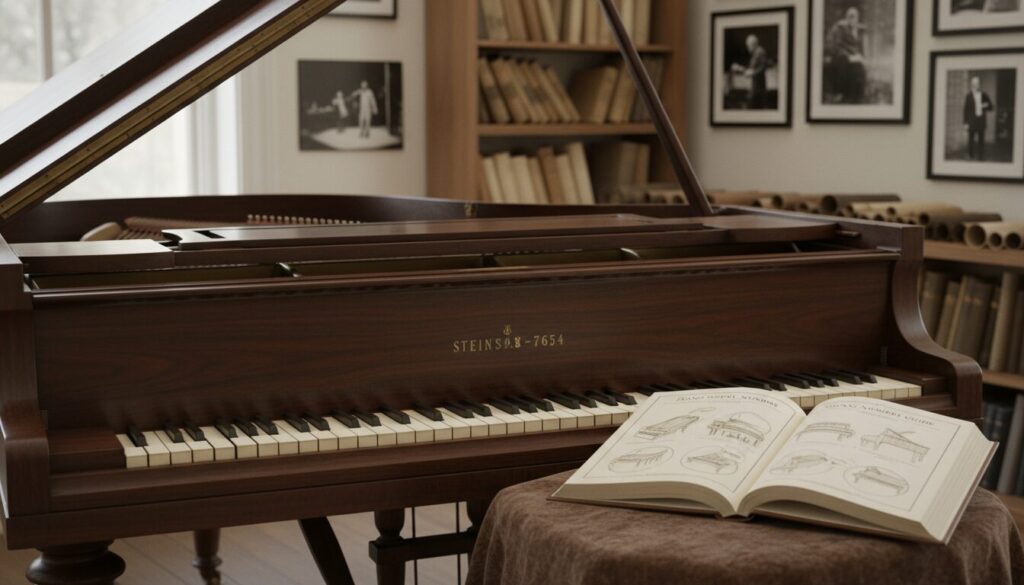
The nuances of serial numbers can often lead to surprising discoveries about your piano’s history. Many factors contribute to how these numbers are assigned and interpreted, making it essential to understand their peculiarities.
Serial Number Ranges Not Always Sequential or Annual
Serial number ranges are not always sequential or annual. Manufacturers sometimes skip blocks of numbers, use separate sequences for different models, or reset numbers after ownership changes. You may encounter situations where a higher number corresponds to an earlier year. This occurs when factories employ non-sequential numbering systems or multiple parallel series.
Manufacturers Starting Serial Numbers at Arbitrary Figures
Some manufacturers preferred to start at much more generous figures. For example, H.P. Nelson’s company began their serial numbers at 6,000 to give the impression of established production volume. This practice was common among several brands.
Serial Number Specials: Thousands-Per-Year Conventions
The thousands-per-year convention was adopted by firms like Ernst Kaps, Collard, and Pleyel. They allotted exactly one thousand numbers per year, regardless of actual production output. When examining serial numbers that follow this pattern, you will notice relatively few numbers with remainders above five hundred, revealing the true production scale.
Some manufacturers maintained separate serial number sequences for grand pianos and upright pianos. This means the same number could appear on two different instruments from the same brand. Understanding these peculiarities is essential for accurate dating. Assuming a simple sequential progression can lead to errors of decades in estimating your piano’s age.
The experts at www.vestapiano.ca are familiar with these production variations across hundreds of brands. They can provide accurate interpretations of unusual serial number patterns for Canadian piano owners.
How to Deal with Pianos Without Visible or Known Serial Numbers
There are instances when the serial number on your piano may be completely hidden or even missing. This situation often arises with lesser-known brands or instruments produced during tumultuous times, such as wars. Don’t be discouraged; sometimes, the number is just well concealed within the instrument.
In antique pianos, the action maker’s name and number can serve as the only clues to its identity and help determine its date. Understanding how to approach these situations is essential for any piano owner.
Hidden or Missing Serial Numbers
Hidden or missing serial numbers are more common than you might expect. This is especially true for pianos from lesser-known manufacturers, instruments produced during wartime, or those that have undergone extensive restoration. In these cases, it’s important to explore all potential hiding spots.
Using Alternative Identification Methods
When a serial number cannot be located, you should first exhaust all possible hiding spots. Check underneath the piano, behind removable panels, and on internal action components. Additionally, consider these alternative identification methods:
- Examine the action maker’s name and number, which can provide valuable dating clues.
- Analyze the design of the case, style of the legs, type of music desk, and overall cabinet construction. These details can help experts estimate the manufacturing period even without a serial number.
- Look for date-marks, patent numbers, and registered design numbers on internal components. These can sometimes be researched through official channels to establish an approximate production date.
When to Seek Professional Appraisal
If your piano lacks a visible serial number and alternative methods have not yielded conclusive results about its age or origin, it’s time to seek professional appraisal. Professional appraisers have access to reference libraries with thousands of images. They can compare your instrument’s characteristics against documented examples for accurate identification.
For assistance with identifying pianos with missing or obscured serial numbers, consider reaching out to www.vestapiano.ca. They specialize in using comprehensive visual analysis and industry expertise to determine your instrument’s background.
Identifying Serial Numbers on Piano Components and Cases
Identifying the serial numbers on various components of your piano can reveal important details about its history. Each part of your instrument may hold unique markings that help trace its origins and specifications.
Numbers on Removable Case Parts
Removable wooden parts of the case, such as legs, music desks, and lid panels, often bear numbers. These are typically the last three digits of the full serial number. This practice helps keep matching components together during assembly.
You will often find these abbreviated numbers repeated across multiple removable parts. This repetition confirms that they belong to the same instrument, although they do not represent the complete serial number.
Imprints on Soundboards and Iron Frames
Imprints on soundboards are among the most reliable serial number locations. Manufacturers frequently stamp or paint the full number directly onto the soundboard near the brand name. This location is usually easy to access and provides essential identification.
On the other hand, numbers cast into iron frames are mold markings for the frame itself. These do not identify your specific piano. However, numbers painted onto the iron frame may indeed be the genuine serial number.
Differences Between Ink Stamps and Metal Imprints
The difference between ink stamps and metal imprints is significant. Ink stamps are often found on keys and paper labels, while metal imprints are hammered into wood surfaces and are more permanent. Metal imprints in wood are not burnt or engraved but are created by hammering metal stamps into the surface, sometimes with coloring added for visibility.
Interestingly, some manufacturers used the capital letter “I” to represent the number one. Occasionally, two “I” marks are superimposed at right angles to serve as an asterisk confirming the serial number.
For help distinguishing between component numbers and the true serial number on your piano, www.vestapiano.ca provides expert analysis of all markings and their significance. Their expertise can clarify which numbers are relevant for identification.
Understanding the Relationship Between Serial Numbers and Piano Manufacturing History
The connection between serial numbers and piano manufacturing history is both intricate and fascinating. Each piano’s serial number can reveal insights into its origins and the practices of the factory that produced it. Understanding this relationship is essential for any piano owner.
How Factory Practices Influence Serial Numbering
Factory practices significantly influence serial numbering. Each manufacturer developed unique systems for assigning and recording numbers based on their production workflows and record-keeping methods. For instance, Steinweg made 482 pianos in Germany before moving to New York. His New York “Steinway” pianos began numbering at 483, showcasing how migration shaped numbering history.
Mergers, Brand Ownership, and Their Impact on Serial Numbers
Mergers and changes in brand ownership often resulted in new serial number series being initiated. For example, when the Winter Piano Company absorbed W.P. Haines, they continued production under a new numbering system. This shift can complicate the dating of pianos, as seen with the Haines Brothers, established in 1851, which transitioned from square grand pianos to uprights in 1870.
Notable Historical Cases in Serial Number Research
Notable historical cases illustrate the complexities of serial number research. Brands like Aeolian acquired numerous piano companies, integrating their numbering systems. This can lead to confusion when trying to trace a piano’s history based solely on its serial number.
Understanding how factory practices, mergers, and historical events shaped serial number sequences helps you appreciate why dating your piano requires more than simply matching numbers to a list. For detailed insights into how manufacturing history affects your specific piano’s serial number, www.vestapiano.ca offers expertise grounded in comprehensive knowledge of piano industry history.
| Factor | Description | Impact on Serial Numbers |
|---|---|---|
| Factory Practices | Unique systems for assigning numbers | Influences how serial numbers are recorded |
| Mergers | Brand ownership changes | Can lead to new serial number series |
| Historical Events | Impact on production and record-keeping | May cause irregularities in numbering |
| Brand Integration | Acquisition of multiple companies | Complicates serial number tracking |
| Manufacturing Evolution | Changes in production focus | Documented through serial numbers |
Conclusion
Unlocking the secrets of your piano’s serial number opens a door to its rich history. Understanding the significance of this number can greatly enhance your appreciation for the instrument.
Looking up a piano serial number is a systematic process that combines careful physical inspection with research using published databases and expert resources to determine your instrument’s age. You now understand that serial numbers are the key to unlocking your piano’s manufacturing date, provenance, and place within the broader history of piano production and craftsmanship.
Remember that while these numbers provide valuable information, they should be cross-referenced with visual identification, date-marks, and professional consultation for the most accurate results. Your piano’s serial number affects its value, documents its history, and connects your instrument to the rich tradition of piano manufacturing that spans centuries and continents.
For Canadian piano owners, www.vestapiano.ca stands ready to provide expert assistance with serial number lookups, professional appraisals, and comprehensive information about your instrument. By documenting and preserving your piano’s serial number information, you contribute to the ongoing effort to maintain accurate records for future generations of piano enthusiasts and owners.
FAQ
What is the significance of a piano’s serial number?
A piano’s serial number helps identify its age, brand, and manufacturing details. This information is crucial for understanding the instrument’s history and value.
Where can I typically find the serial number on my piano?
Serial numbers are often located on the back of the piano, inside the lid, or on the frame. For grand pianos, check the soundboard or the iron frame.
Are all piano serial numbers formatted the same way?
No, different brands may use various formats. Some might include letters, while others consist solely of digits. Familiarizing yourself with your brand’s specific format is essential.
How can I use the serial number to determine my piano’s value?
By referencing published serial number lists and comparing your number with known ranges, you can estimate the piano’s worth based on its age and brand.
What should I do if my piano has no visible serial number?
If the serial number is hidden or missing, consider alternative identification methods, such as examining other components or seeking professional appraisal for more insights.
Can serial numbers vary significantly between different models of the same brand?
Yes, some brands may have complex serial number systems that differ across models or production years, making it essential to research specific details for accurate identification.
What are some common myths about piano serial numbers?
One common myth is that serial numbers provide an absolute date of manufacture. In reality, various factors can influence the accuracy of this information.
How can I safely inspect my piano for its serial number?
When inspecting, ensure to handle heavy components carefully and take necessary safety precautions, especially if crawling underneath or removing parts.
Are there online resources available for looking up piano serial numbers?
Yes, online databases like Klaviano and the Blue Book of Pianos can provide valuable information regarding serial numbers and their corresponding details.
Why is it important to document my piano’s serial number?
Documenting the serial number helps preserve important information about your piano, making it easier to reference for maintenance, resale, or historical purposes.