

Have you ever wondered what stories your instrument holds within its unique markings? Each Yamaha piano carries a serial number that reveals its age, manufacturing history, and even the factory where it was built. This information can be invaluable for both music enthusiasts and collectors alike.
In this guide, you will learn the essential steps to locate and interpret your piano’s serial number. Understanding this number not only enhances your appreciation of your instrument but also helps you make informed decisions regarding maintenance, resale, and authenticity.
Whether you own a grand or an upright model, knowing how to find and decode your piano’s serial number is crucial. With this knowledge, you can confidently explore the rich history behind your Yamaha piano.
Key Takeaways
- Learn the complete process of finding your piano’s serial number.
- Understand the significance of the digits and letters in the serial number.
- Discover the historical context and manufacturing details of your instrument.
- Gain confidence in verifying authenticity and assessing value.
- Receive expert guidance from Vestapiano Inc for personalized assistance.
Understanding Your Intent When Looking Up Yamaha Piano Serial Numbers
Understanding the reasons behind your search for a piano’s serial number can significantly enhance your experience. Your intent shapes how you will use the information once you find it. Before diving into the physical search, clarify why you need this data.
Many owners look up their serial number to determine the exact age of their instrument. This is essential for insurance purposes, assessing resale value, or simply satisfying personal curiosity about the history of their piano.
If you plan to sell your Yamaha piano in the Canadian market, knowing the serial number allows you to accurately list the year of manufacture and factory origin. This information can significantly impact buyer confidence and pricing.
The serial number also helps you verify whether your instrument was made for the North American market or if it is a grey market import. This distinction affects warranty coverage and parts availability in Canada.
Understanding your intent allows you to focus on the most relevant details when interpreting the serial number. You may need to know the specific factory location or just the approximate year of manufacture.
Yamaha pianos have been produced in six distinct manufacturing locations. The serial number is the key to unlocking which factory produced your instrument and when.
Some owners research serial numbers to confirm authenticity before purchasing a used piano. This ensures they are not misled by sellers who may misrepresent the instrument’s age or origin.
The numbers stamped on your piano connect you to a global history of craftsmanship. Understanding your intent makes the research process more meaningful and directed.
Whether you are a professional technician, a piano teacher, or a casual player, knowing your Yamaha piano serial number empowers you to make informed decisions about maintenance, restoration, or upgrades.
Vestapiano Inc regularly assists Canadian clients with specific questions about their Yamaha pianos after locating the serial number. You can reach them at 647-832-2177 for tailored advice.
Locating the Serial Number on Your Yamaha Piano
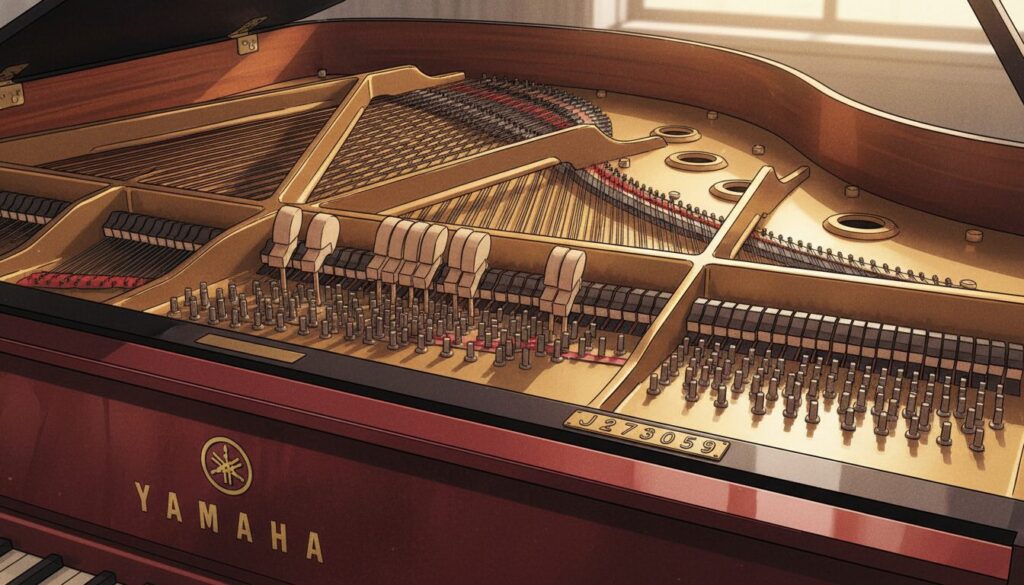
Finding the serial number on your instrument is a crucial step in understanding its history. The method for locating this number varies depending on whether you own a grand or an upright piano. Knowing where to look will save you time and enhance your appreciation of your instrument.
Finding Serial Numbers on Grand Pianos
For Yamaha grand pianos, the serial number is stamped on a gold-colored plate located inside the piano. Typically, you can find it by standing at the keyboard and looking toward the tuning pins on the cast iron plate.
Before you start your search, consider removing the music desk. You may also want to gently clean any dust from the piano’s plate using a soft dry cloth or vacuum hose. This will help make the serial number more visible.
In addition to the gold plate, the serial number can also be found on the Capo d’astro bar on the right side, on the soundboard itself, or on a metal plate underneath the piano’s top lid near the strings.
If the number isn’t immediately visible, check the back of the keyslip, the front of the action frame after removing the keyslip, or stamped on one or both of the cheek blocks located to the right and left of the keyboard.
When removing cheek blocks, exercise caution. Avoid mistaking the piano’s leg screw or bolt with the cheek block’s screw. Be careful not to drop the cheek blocks, as this can gouge and permanently damage the piano’s case.
Finding Serial Numbers on Upright and Vertical Pianos
For Yamaha upright and vertical pianos, the serial number is also stamped on a gold-colored plate inside the piano. You can see it by opening the top lid and looking inside.
On upright pianos, the serial number may be located on the cast iron plate after lifting the lid. Look along the top front area of the plate to the right, left, or in the middle.
Additional locations for the serial number on upright pianos include:
- Under the opened lid on the ledge, stamped on a little plaque.
- Stamped on the back of the piano near the top of the wood frame.
- Printed on one of the hammers, found on either end of the piano.
- Printed on one of the keys behind the nameboard inside the piano.
The picture references available for both grand and upright Yamaha pianos make it significantly easier to identify exactly where to look. If you still cannot find the serial number after checking all these locations, Vestapiano Inc can provide expert guidance specific to your model. Call 647-832-2177 for immediate assistance.
Interpreting Yamaha Piano Serial Numbers: Manufacturing Locations and Dates
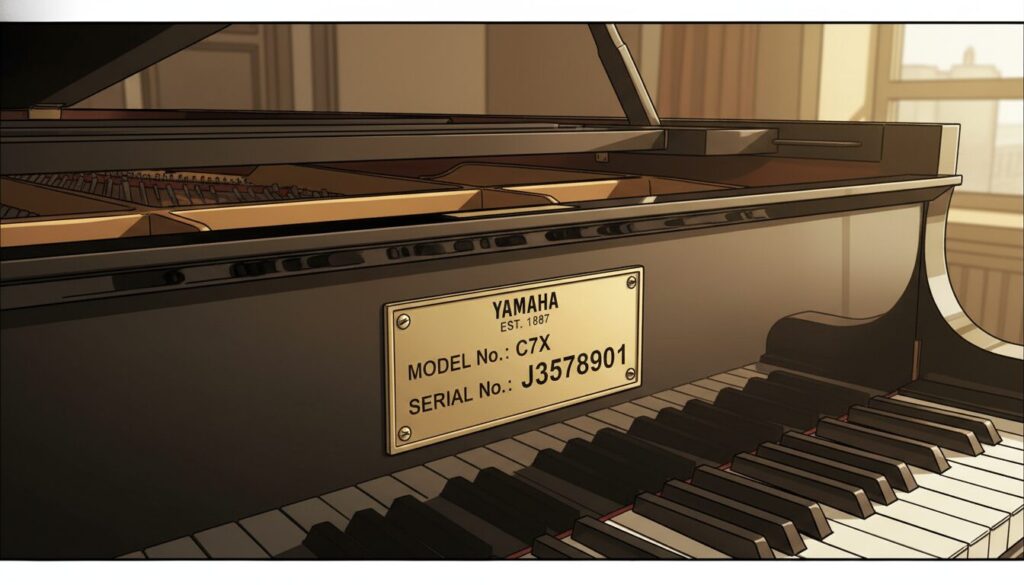
Understanding the serial number can unlock a wealth of information about your piano’s past. Once you have located the serial number on your instrument, the next step is interpreting what those digits and letters reveal about its manufacturing location and year of manufacture.
Decoding Serial Number Prefixes by Factory
Yamaha pianos produced for the North American market have been manufactured in six distinct locations. The prefix of your serial number immediately identifies which factory produced your piano:
- If the serial number begins with a “T”, your instrument was manufactured in Thomaston, Georgia. Specific grand piano models, including the GH1G, GH1FP, GC1G, and GC1FP, were exclusively produced at this facility.
- A serial number that begins with a “U” indicates the piano was manufactured in South Haven, Michigan, with production spanning from 1974 starting at serial number U101000 through 1986 ending at U186000.
- If the serial number begins with an “H”, your piano was manufactured in Hangzhou, China, where production started in 2004 with serial number H0004000 and continues to the present day.
- When the serial number begins with “YT”, the piano was manufactured in Taoyuan, Taiwan, with production documented from 2004 starting at YT277800 through 2006 at YT285000.
- If your serial number starts with “J”, the piano was manufactured in Jakarta, Indonesia, where specific grand piano models were produced starting in 1999.
- For any other grand piano model not specifically mentioned, it was manufactured in Hamamatsu, Japan, which is the original and primary Yamaha manufacturing facility.
Matching Serial Numbers to Year of Manufacture
Matching your serial number to the year of manufacture requires consulting detailed charts that map number ranges to specific years. For example:
- Hamamatsu grand pianos reached serial number 6500000 by 2020.
- Thomaston pianos ended at T294877 in 2004.
- Indonesian production reached J39 by 2022.
The serial number system is comprehensive and consistent. It allows you to pinpoint not only the year but often the specific month of manufacture for pianos produced in Hamamatsu, Japan. Understanding that the number begins with specific letters is the fastest way to narrow down your piano’s origin.
Vestapiano Inc specializes in helping Canadian piano owners interpret complex serial number data. For a professional assessment of your Yamaha piano’s manufacturing details, call 647-832-2177.
Conclusion
Understanding your instrument’s unique identifiers can unlock a treasure trove of history. You now have the tools to locate and interpret the serial number on your piano. This number serves as a direct link to your instrument’s past, revealing its origin and year of manufacture.
With this knowledge, you can make informed decisions about care, insurance, and resale value in the Canadian market. Remember, the gold-colored plate inside your piano holds the key to this valuable information.
If you have any remaining questions or wish to schedule a professional appraisal, contact Vestapiano Inc at 647-832-2177. Their expert team is ready to assist piano owners across Canada with personalized service.
FAQ
Where can I find the serial number on my Yamaha grand piano?
The serial number is typically located on the plate inside the piano, near the tuning pins. You may need to lift the lid to access it.
How can I tell the age of my Yamaha upright piano?
You can determine the age by locating the serial number and referencing it against Yamaha’s manufacturing date charts, which are available online.
What does the prefix in the serial number indicate?
The prefix often indicates the factory where the instrument was manufactured, such as Hamamatsu or Hangzhou, which can help you identify its origin.
Are there any online resources to help me decode Yamaha piano serial numbers?
Yes, several websites provide detailed guides and charts for decoding Yamaha serial numbers, helping you understand the year and location of manufacture.
Can I find the serial number on a digital Yamaha piano?
Yes, for digital models, the serial number is usually found on the back or bottom of the instrument, often on a sticker or engraved plate.
What should I do if the serial number is worn off?
If the serial number is not visible, consider contacting Yamaha customer service with your model details. They may assist in identifying the instrument.